






Designing a small bathroom is often a matter of making every centimetre work harder.
In a compact ensuite, downstairs cloakroom or narrow family bathroom, even seemingly minor details can have a surprisingly big impact on the finished layout. A vanity that is slightly too wide can restrict movement, a shower enclosure can make the room feel cramped, and a conventional radiator can take up valuable wall space that could otherwise be used for storage or mirrors.
Heating is therefore worth considering early in the design process rather than treating the radiator as an afterthought.
One increasingly practical option for compact bathrooms is a 350mm wide towel radiator. Narrow enough to fit into tighter areas but still capable of providing useful towel-hanging space, this type of radiator can combine practicality with a more considered interior design.
Why Radiator Size Matters in a Small Bathroom
When planning a bathroom, it is easy to concentrate on the larger fixtures: the bath, shower, toilet and basin. However, the smaller elements can determine whether the finished room feels comfortable or overcrowded.
A conventional 500mm or 600mm-wide towel radiator may work perfectly well in a larger bathroom, but it can become difficult to position in a smaller room.
For example, a wider radiator could interfere with:
- A bathroom door opening
- A shower enclosure
- A vanity unit
- Wall-mounted storage
- A mirror
- Existing pipework
- Available walking space
A narrower radiator provides another option. A 350mm-wide towel rail can fit into spaces where a wider model may not be practical, allowing the wall to be used more efficiently without giving up the convenience of having warm towels close to the shower or bath.
Small Doesn’t Have to Mean Insignificant
One of the advantages of choosing a narrow radiator is that width is only one part of the equation.
A radiator can remain relatively narrow while increasing in height. This makes vertical wall space particularly useful in compact bathrooms. For example, exploring a specialized collection like a 350mm wide black towel radiator allows homeowners to choose from various heights depending on the available wall space and the amount of heat required.
The important point is not simply to choose the tallest radiator that will fit. The radiator’s heat output should be considered alongside the size and characteristics of the room.
A small bathroom with good insulation and a modest heat requirement will have different needs from a larger bathroom with an external wall, large window or limited insulation.
The Importance of Measuring Before Buying


When replacing an existing radiator, measurements are particularly important.
The advertised width of a towel radiator is not the only dimension that matters. Homeowners should also consider its height, projection from the wall and, crucially, the position of the pipe connections.
For example, current 350mm-wide models in specialist ranges can have pipe centres of around 300mm. This is an important distinction from the overall radiator width and should not be confused with it.
Before ordering, measure:
- Available wall width
- Available wall height
- Existing pipe centres
- Distance between valves
- Position of the pipework
- Wall projection
- Clearance from nearby fixtures
A new radiator may look perfect on paper but still require pipework adjustments if its connection positions differ from those of the radiator being replaced. Taking measurements first can make the installation considerably more straightforward.
Creating a Designer Look with a Black Towel Radiator
Radiators have traditionally been treated as purely functional objects. In contemporary bathrooms, however, heating can form part of the overall design.
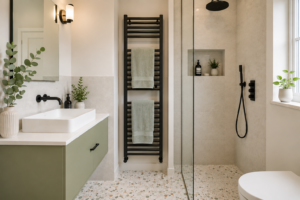
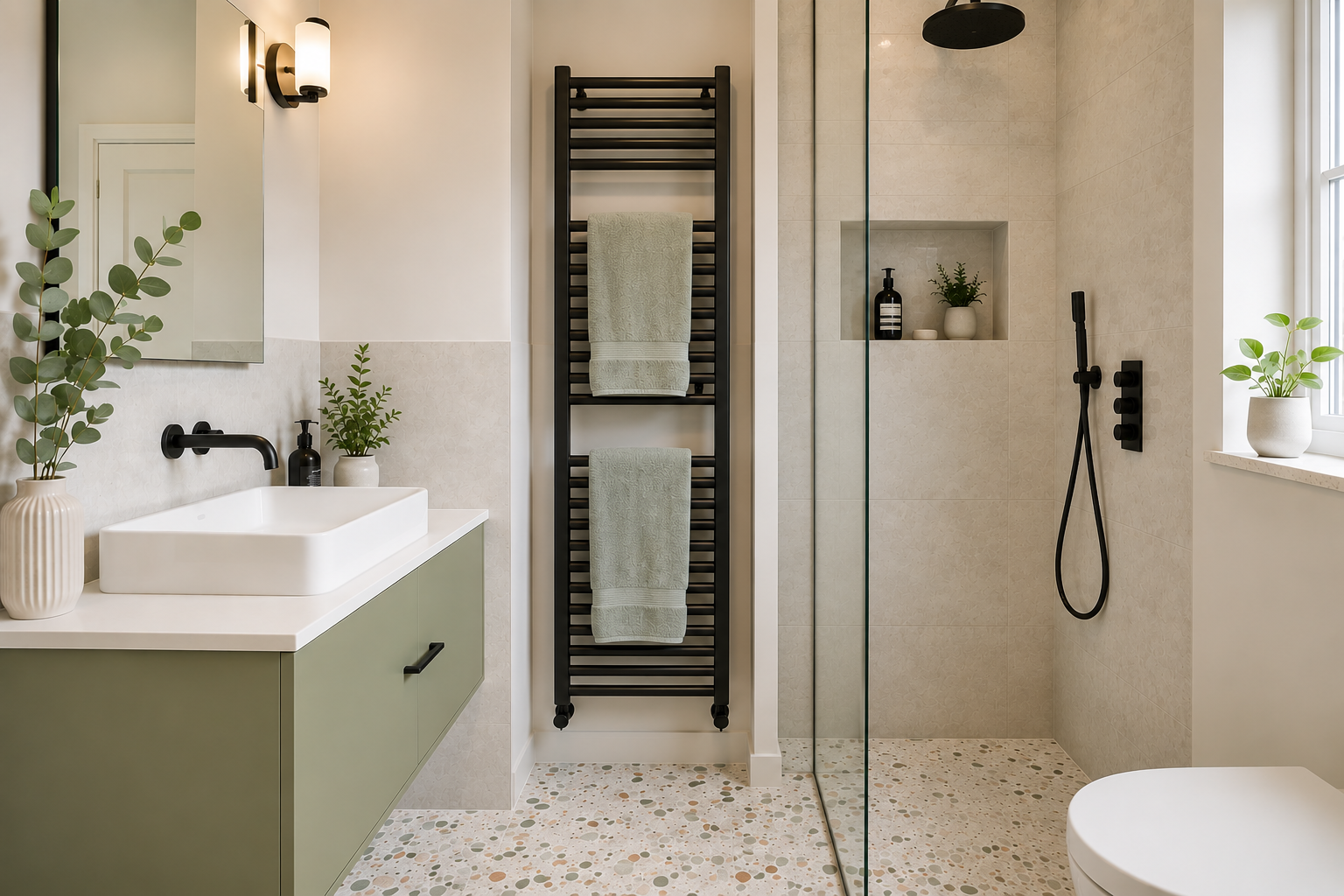
Black finishes are particularly effective when used consistently throughout a bathroom. A matt black towel radiator can be paired with black:
- Basin taps
- Shower frames
- Shower controls
- Vanity handles
- Flush plates
- Wall accessories
- Lighting details
This creates repetition within the colour scheme and helps the individual fixtures feel like part of a coordinated design rather than a collection of unrelated products.
Black can also work particularly well against lighter backgrounds. White sanitaryware, pale stone-effect tiles and natural wood finishes provide contrast without making the room feel visually heavy.
Fresh Design Blog has previously highlighted sleek black radiators as a way of combining practicality with contemporary bathroom styling, so the idea fits naturally into the broader move towards making heating part of the room’s aesthetic.
Making a Narrow Bathroom Feel Bigger

Choosing a smaller radiator is only one part of creating a spacious-looking bathroom. The overall layout matters just as much.
Wall-mounted furniture can help keep the floor visually clear, while a large mirror can increase the sense of space by reflecting light. Frameless or minimally framed shower screens can also help prevent a compact bathroom from feeling divided into separate sections.
Colour plays a role too. Light walls and floors can create an airy appearance, while carefully chosen darker details can provide contrast. A black towel radiator can therefore act as a relatively small but effective design feature rather than dominating the room.
The key is balance. Instead of using black on every surface, repeat it selectively through taps, lighting, accessories and the radiator. This creates visual continuity without making the bathroom feel enclosed.
Choosing the Right Height and Heat Output
A narrow radiator should not be selected on dimensions alone. The required heat output depends on factors including:
- Room size
- Ceiling height
- External walls
- Window area
- Insulation
- Desired room temperature
- Heating system
- Radiator design
Two towel radiators with similar external dimensions can have different heat outputs, so checking the manufacturer’s specifications is important.
For a bathroom renovation, it is worth calculating the approximate BTU requirement before choosing the final radiator. This avoids the common mistake of choosing a radiator because it fits the available wall but doesn’t provide enough heat for the room.
Central Heating, Electric Operation, or Dual-Fuel?

The heating system should also influence your choice. Many towel radiators are designed for connection to a conventional wet central-heating system, while some models can be configured for electric or dual-fuel operation.
- Central Heating: Connected to the home’s heating circuit using appropriate valves and pipework.
- Electric Only: Provides independent heating, useful where connecting to existing pipework is impractical or where homeowners want the ability to heat towels outside the central-heating season.
- Dual-Fuel Systems: Allows the radiator to operate with central heating during colder months and an electric element when the boiler is not running.
Always check the manufacturer’s specifications and installation instructions before purchasing components or converting a radiator.
Don’t Overlook the Valves
Radiator valves may be a small detail, but they can have a significant effect on the finished appearance. For a modern matt black towel radiator, matching black valves can create a much more cohesive look than standard chrome valves.
The type of valve required will depend on the position of the pipework. Angled valves are commonly used where the pipe comes from the wall and needs to turn into the radiator, while straight valves can be appropriate for certain floor-level pipe arrangements.
Final Thoughts
Small bathrooms don’t necessarily require small ambitions. With careful planning, a compact room can still feel comfortable, stylish and well proportioned.
A 350mm-wide towel radiator is one example of how a relatively small design decision can make a difference. By combining a narrow footprint with a precise 300mm pipe centre, flexible heating configuration options, and a finish that complements the rest of the bathroom, it can provide both practical heating and a considered finishing touch.
The best result comes from measuring first, calculating the required heat output and then choosing a radiator that fits both the room and the overall design.
0
Related
Read the full article here


