


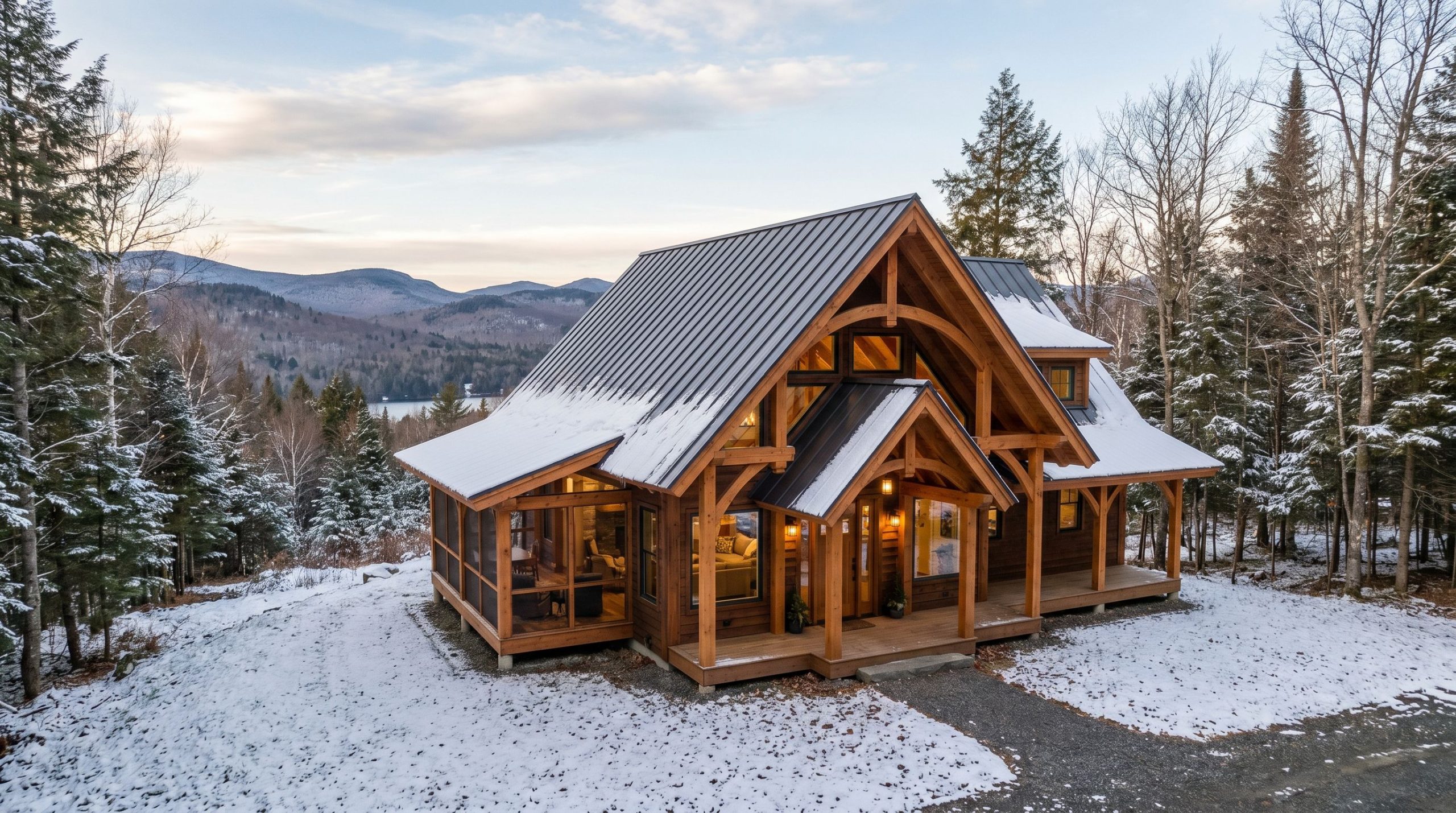
Timber-frame homes belong in New York. Their stout posts shrug off 60-pound snow loads, and open floor plans pull mountain views—or ocean breezes—straight into your living room.
State code makes it easy: Type IV heavy-timber construction already earns a fire-resistance nod, according to the DecoderNY code guide. A structural insulated-panel (SIP) wrap also nails the required R-49 roof and R-20 wall targets, according to a compliance guide from Melt Plan. Costs stay predictable, too—expect roughly $350–$500 per sq ft turnkey, with only one-third covering the frame and SIP shell, according to Vermont Frames.
The five Hamill Creek designs below range from compact cottage to grand lodge, each engineered for New York performance, efficiency, and style.
How we rated the designs
Choosing a timber-frame plan for New York takes more than admiring a pretty rendering. We stacked each Hamill Creek design against a clear scorecard so you can see the “why,” not just the “wow.”
First, we asked whether the frame is truly New-York ready. Snow loads, wind exposure, and Type IV fire classification had to pass without costly redesign. A design that shrugs at a 60-pound snow blanket earned full marks.
Hamill Creek Timber Homes’ cold-climate engineering guide notes that their frames are routinely engineered for roof snow loads between 100 and 250 pounds per square foot, comfortably above New York’s 60-psf benchmark.
That statewide expertise matters because prime build zones, from the Adirondack High Peaks to the breezy Long Island shore, present wildly different climate loads.
The team of New York timber frame builders at Hamill Creek tailors that heavy-snow spec to mountain drifts, lake-effect winds, and coastal salt spray, so one design playbook works across the entire map.
Next came energy discipline. Plans had to meet the state’s R-49 roof and R-20 wall targets straight out of the box. Anything that pairs cleanly with SIP panels scored high because it locks in lower heating bills from day one.
Price clarity mattered as well. We favored layouts with a published kit cost or enough build history to peg a realistic turnkey range. If you can’t budget it, you can’t build it.
Finally, we looked at livability and flexibility: main-floor suites, home-office nooks, and room for future wings. After all, a house should bend with your life, not box it in.
Each factor carried a specific weight: performance 30 percent, cost 25, livability 20, build simplicity 15, style fit 10. The weighted scores roll into one ranking so the best overall choice rises to the top.

1. Kaslo Cottage: compact, light-filled retreat

Kaslo Cottage compact light-filled timber frame home exterior.
Kaslo proves that big character fits in a small box. At 1,272 square feet, the two-story frame feels airy thanks to a cathedral great room that lifts daylight from floor to ridge. You walk in and see cedar posts rising past the loft railing toward sky-high windows. The room borrows volume from the outdoors, not dollars from your budget.
Practicality scores high. One bedroom and a full bath sit on the main level, so day-to-day living stays stair-free. The second floor holds a private suite and a small loft overlooking the great room, perfect for a reading nook, yoga perch, or work-from-home desk. Because the roofline stays simple, crews spend less time cutting valleys and more time closing in the shell. That saves money and shortens the schedule.
Kaslo also wins on energy discipline. Its tidy rectangle wraps easily in 6-inch SIP walls and 10-inch roof panels, meeting the state’s R-49 roof and R-20 wall targets without fuss. Fewer corners mean fewer thermal bridges, so your heat stays inside when January turns brutal.
Budget watchers appreciate the math. With Hamill Creek timber-frame kits ranging from $60 to $300 per square foot, and finished homes in the Northeast typically starting between $350 and $500 per square foot, Kaslo sits squarely in the mid-budget lane while still displaying handcrafted beams in every sightline.
Where does it belong? Picture an Adirondack lake lot, a Finger Lakes vineyard edge, or a tight Catskill clearing. The covered porch welcomes muddy boots, the loft window frames autumn foliage, and the modest footprint slips between trees without calling for heavy equipment.
In short, Kaslo delivers the timber-frame dream: soaring ceiling, honest joinery, and postcard windows without the sprawl or sticker shock. It ranks first because it balances beauty, resilience, and cost better than any other plan on the list.
2. Appledale Cottage: kit pricing without kit aesthetics

Appledale Cottage pre-priced timber frame kit exterior.
Appledale suits buyers who want handcrafted timber character and a firm number before breaking ground. Hamill Creek lists the starting kit at $105,000, calming the budget conversation from day one.
At 1,915 square feet, the cottage feels open yet stays builder-friendly. A single rectangular footprint simplifies site work, while vaulted trusses draw the eye upward and erase any hint of “budget.” Walk through the front doors and sunlight reflects off Douglas-fir beams, filling an open living-kitchen hub built for holiday dinners.
Daily life happens on one floor. The primary suite, laundry, and mudroom sit on the main level, so empty-nest owners avoid stairs unless they want a different view. Overhead, an open loft hovers above the great room and doubles as guest bunk, art studio, or home office with Wi-Fi that never passes through a floor deck.
Appledale’s ace is future growth. Add a walk-out basement and two more bedrooms appear without touching the roof. Young families can start modest and finish added space later when cash flow improves.
Efficiency follows form. Compact geometry means fewer corners to leak heat and less exterior wall per square foot. Wrap the shell in SIPs and the cottage meets the R-49 roof and R-20 wall targets, keeping winter heating loads small enough for one ductless heat pump plus a wood stove for mood lighting.
With Northeast turnkey costs usually between $350 and $500 per square foot, Appledale becomes a genuine value play where many custom homes start with a seven. Place it on a Hudson Valley hillside or tuck it behind a main house as the ideal in-law cottage; either way, it delivers artisanal joinery, a flexible layout, and a price you can quote to your banker with confidence.
3. Rocky Mountain: family-sized lodge with everyday practicality

Rocky Mountain family-sized timber frame lodge with hammer-beam entry.
Rocky Mountain welcomes you with a hammer-beam entry that recalls an Adirondack great camp. Step inside and a vaulted great room wrapped in glass pulls the landscape into every corner of the house. Beneath that striking ceiling lies a floor plan built for daily life, not just weekend photos.
The main level runs in a simple loop. Kitchen, dining, and living areas share one soaring ridge, so conversation never has to climb walls. A sliding wall opens to a screened porch and open deck, creating a bug-free dinner spot and a sunny coffee perch in one move. Off the foyer, a quiet office lets remote workers close a door without losing quick access to the snack drawer.
All bedrooms sit upstairs, keeping noise down when parents linger by the fire. The primary suite stretches across the rear gable for the best view, while two secondary bedrooms and a shared bath fill the opposite wing. A loft lounge bridges the gap, ideal for homework or late-night board games under exposed trusses.
Structure and envelope defend against New York winters. Steep roof pitches shed lake-effect snow, and SIP roof panels turn the large volume into a tight thermos. Builders appreciate the straight gables and minimal valleys; fewer complex cuts mean faster dry-in and fewer call-backs.
Northeast turnkey costs usually start between $350 and $500 per square foot. That budget delivers 2,526 square feet of heirloom timber, a screened porch that doubles usable space for three seasons, and craftsmanship often found in boutique resorts.
Rocky Mountain excels on view lots such as Lake George bluffs or Catskill ridgelines, where the glass wall can capture sunrise without a neighbor in sight. It holds the middle rank because it pairs lodge presence with the practical spaces a family uses Monday through Sunday.
4. Hawaii Hale: one-level living with a resort-style lanai
If your dream home blurs the line between indoors and out, Hawaii Hale delivers year-round summer even in New York. The design spreads 1,600 square feet across a single floor and adds a 580-square-foot covered lanai that functions as an outdoor living room. Open the double glass doors and the great room nearly triples in perceived size without touching the thermostat.
Inside, scissor-truss ceilings lift breezes through clerestory windows while spotlighting the timber work above. The kitchen anchors one end with a broad island that invites friends to linger while you finish the risotto. On the opposite side, a flexible alcove toggles between formal dining and home office, perfect for remote workdays that end with an easy stroll to the lanai.
The primary suite sits in a quiet wing, buffered by a guest powder room so visitors never cross your spa bath. Zero steps, wide doorways, and optional flush shower entries make aging in place simple. Swap hardwood for polished concrete with radiant heat and you can walk barefoot across warm floors even when snow piles high outside.
Before shipping east, the broad hip roof gets a snow-country update: steeper pitch, stronger ridge, and SIP panels that stack R-50 insulation above the dramatic timbers. Compact, airtight walls let a single mini-split handle most heating and cooling, while a wood stove on the lanai turns crisp October evenings into relaxed story time.
Northeast turnkey costs usually start between $350 and $500 per square foot. The final budget depends on how much high-performance glass you choose for the indoor-outdoor wall. Invest in folding panels now and you will enjoy every breeze that drifts through.
Ideal settings include a Finger Lakes vineyard row, a sheltered Hudson Valley meadow, or any site where privacy lets you swing those doors wide. Build it and every Friday evening can feel like a mini vacation.
5. Crow’s Nest: grand Adirondack lodge for view-hungry sites

Crow’s Nest grand Adirondack timber frame lodge exterior with glass wall.
Crow’s Nest covers 3,240 square feet of heavy-timber drama pointed straight at the horizon. A hammer-beam entry framed in stone leads to a two-story great room where a glass wall blurs the line between sofa and skyline.
The floor plan welcomes a crowd. A main-level guest suite lets grandparents or short-term renters skip stairs, while an office with deck access turns remote work into lakeside work. Three sets of French doors open to a full-width deck, half shaded for midday comfort, half open for star watching after the marshmallows are gone.
Upstairs, the owners retreat to a private wing with sunrise views and a spa bath. Two additional bedrooms flank a loft lounge that looks over the great room. Children can stream a movie while adults chat by the fire below, everyone connected yet uncrowded.
Engineering keeps pace with the aesthetics. Hammer-beam trusses clear spans that would normally need posts, yet the frame still meets 60-pound snow requirements common in the Adirondacks. Add SIP panels and triple-pane glass, and the vast interior stays warm when February arrives.
Northeast turnkey costs typically start between $350 and $500 per square foot. Roughly one-quarter to one-third of that covers the frame and insulated envelope, buying a property ready for holiday gatherings now and solid resale decades from today.
Crow’s Nest belongs on a ridgeline, lake bluff, or vineyard crest where the view commands respect. Build it and guests will pause at the threshold, speechless for a moment before they step inside.
Quick-glance comparison table
| Design | Heated area | Beds / baths | Signature feature | Shell package approx. | Typical turnkey range | Best fit |
| Kaslo Cottage | 1,272 sq ft | 2 / 2 | Vaulted great room under compact gable | $60–$300/sq ft | $350–$500/sq ft | Small family lake cabin or downsizer |
| Appledale Cottage | 1,915 sq ft | 1+ / 2.5 | Pre-priced kit, hammer-beam porch | Starts at $105k | $350–$500/sq ft | Budget-savvy couple, expandable guest house |
| Rocky Mountain | 2,526 sq ft | 3 / 3 | Hammer-beam entry + screened porch | $60–$300/sq ft | $350–$500/sq ft | Year-round family lodge with office |
| Hawaii Hale | 1,600 sq ft + 580 lanai | 1 / 1.5 | Indoor-outdoor scissor-truss great room | $60–$300/sq ft | $350–$500/sq ft | One-level retreat on private view lot |
| Crow’s Nest | 3,240 sq ft | 4 / 3.5 | Two-story glass wall, full-width deck | $60–$300/sq ft | $350–$500/sq ft | Legacy Adirondack estate or luxury rental |
Note: “Shell package” includes the timber frame and SIP envelope delivered to site; turnkey ranges include foundations, mechanicals, finishes, and typical New York build costs as of 2026.
Find your best fit in 30 seconds
You want a tiny mortgage and a vaulted living room? Choose Kaslo.
You need a published kit price and space to grow later? Pick Appledale.
You like lodge character plus bedrooms for teens and guests? Select Rocky Mountain.
You prefer single-level living that opens wide to the outdoors? Go Hawaii Hale.
You own a view lot that deserves a dramatic frame? Build Crow’s Nest.
Decision made? Great. On to the questions.
FAQs: building a timber-frame home in New York
Will local code inspectors allow all that exposed wood?
Yes. Heavy-timber construction falls under Type IV in the New York codes, which recognize the built-in fire resistance of large members. Submit stamped plans and inspectors will sign off.
How much will the whole project cost?
Plan on $350 to $500 per square foot in today’s market. About one-third pays for the frame and SIP shell; the rest covers finishes, mechanical systems, and site work.

Is a vaulted great room hard to heat?
No. Continuous SIP roof panels provide high R-values, and a slow ceiling fan pushes warm air back to the floor. Many owners report lower bills than in smaller stick-built homes.
How long from breaking ground to move-in?
Allow roughly 12 months. The frame rises in days; finishing trades, inspections, and weather set the pace for the rest.
Can I tweak these plans?
Absolutely. Hamill Creek treats each design as a starting point. Want an attached garage, steeper roof, or net-zero spec? Their team revises the joinery and issues new engineering calcs before cutting timber.
Do timber homes need extra maintenance?
Interior beams need little beyond dusting. Outdoors, re-stain exposed wood every few years, just like cedar siding. Keep gutters clear and direct water away; the frame will outlast several roofs and HVAC systems.
Conclusion
New York’s climate and codes make heavy-timber construction a natural fit, and Hamill Creek’s plans show just how flexible—and attainable—a custom timber-frame home can be. Whether you crave a tiny-footprint retreat or a legacy lodge, one of these five designs can anchor your dream build and stand strong for generations.
0
Related
Read the full article here