





Two rooms can be almost identical on paper and still feel completely different to live in.
One might look onto mature trees, with shifting light and leaves moving outside the window. Another might face a busy pavement, neighbouring buildings or an open stretch of sky. The furniture could be similar, the wall colour could be the same, and yet the atmosphere inside each room would not be quite the same.
That is because we do not experience our homes in isolation.
What sits beyond the windows, where the front door opens, how daylight enters, whether there is a garden or balcony, and even the movement happening outside all become part of everyday life indoors. The boundaries of a home may be clear on a floor plan, but the experience of living there often stretches well beyond them.
Looking at your surroundings as part of the home can change the way you think about layout, furniture, privacy and even the small details that make a room feel settled.
Your Windows Frame More Than a View
Windows are usually discussed in practical terms. They bring in daylight, provide ventilation and help a room feel more open.
But they also frame whatever happens to be outside.
That might be a garden, rooftops, mature trees, neighbouring properties, a quiet courtyard or a lively street. Even when you are not deliberately looking outside, that backdrop becomes part of the room.
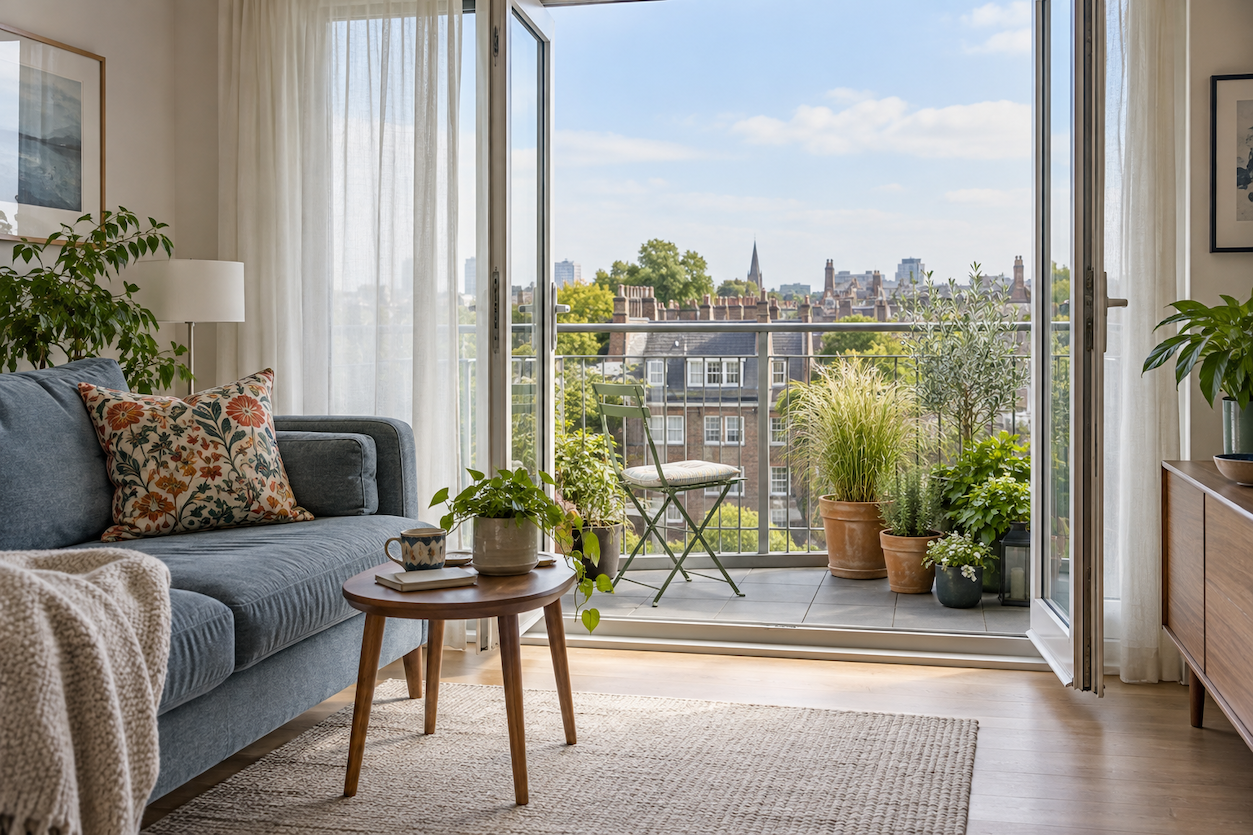
A green outlook can add movement and seasonal colour. A dense urban view can make the architecture outside feel almost like another layer of the interior. Open sky can make a relatively modest room feel more spacious, while a close neighbouring building can create a stronger sense of enclosure.
This is one reason furniture placement works better when it responds to the actual setting rather than simply following a standard room layout.
If one window has the strongest view, it may make sense to arrange seating so you can enjoy it. If a window faces a busy pavement, you may prefer to position furniture slightly differently or use curtains, blinds or planting to create more privacy without shutting out all the daylight.
The important point is that the view is already part of the room. Good design notices it.
The Front Door Is a Threshold, Not a Hard Boundary
It is easy to think of the front door as the point where the outside world ends and home begins.
In reality, arriving home usually happens gradually.
You may walk along a path, pass a front garden, climb a few steps, cross a shared entrance or move from a pavement into a porch. Those few seconds create a transition between public and private space.
A front entrance does not have to be grand to make that transition feel considered.
A clear path, a working exterior light, a couple of healthy plants or simply a tidy approach can make arriving home feel calmer and more intentional. Equally, an entrance that feels cramped, poorly lit or visually confused can affect the experience before you have even stepped inside.
This is less about creating perfect kerb appeal and more about noticing how you actually approach your own home.
Where do you pause to find your keys? Is there somewhere for wet shoes or muddy boots once you come inside? Does the entrance feel connected to the hallway beyond it? Can you see straight through to the garden, or does the arrival feel more enclosed?
These are small details, but they shape one of the most repeated experiences in any home: leaving and coming back.
Gardens and Balconies Can Become Part of the Living Space


A garden, terrace or balcony does not have to be large to influence life indoors.
Even when the weather means you are not using the outdoor space every day, you still see it. Light reflects from it. Plants may be visible from several rooms. Doors and windows create a visual connection between the two areas.
When that connection is strong, the outdoor area can begin to feel like an extension of the home.
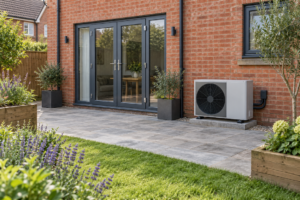
This might be as simple as positioning a chair where you can see the garden, continuing similar materials near an exterior door or choosing planting that looks good from inside as well as outside.
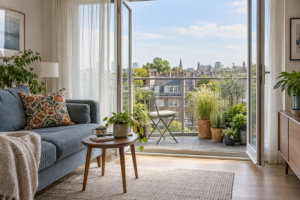
If you have a small balcony, the view from the room may matter more than how much furniture you can fit onto it. A few well-chosen pots, a simple chair or some greenery can create something pleasant to look towards even when you are indoors.
Larger gardens offer more possibilities, but the principle is the same. The strongest outdoor spaces often feel connected to the life happening inside rather than like separate areas that happen to sit behind the house.
Think about which rooms overlook the garden and how those views change through the year. A tree that creates shade in summer might allow far more light through in winter. A dining area near patio doors might feel completely different once the garden beyond it becomes part of the picture.
The outside does not need to match the interior perfectly. It simply needs to feel related to it.
Light, Sound and Movement Cross the Property Line
Not everything that enters a home from outside is visual.
Sound travels through open windows. Trees move in the wind. People pass along the pavement. Cars arrive and leave. Sunlight shifts across a wall during the day. Shadows from nearby buildings change with the season.
These things are part of the background rhythm of a home.
You do not necessarily need to eliminate them. In many cases, the better approach is simply to understand them and design with them in mind.
If a room receives strong afternoon sun, the furniture, fabrics and window coverings may need to cope with that. If a particular side of the house feels darker because of surrounding buildings or trees, mirrors and lighter surfaces may help make better use of the daylight that is available.
Privacy can also be handled in layers rather than by permanently covering a window.
Sheer curtains, café-style blinds, tall planting or furniture placement can all soften the relationship between a room and the space outside without cutting it off completely.
Sound is similar.
Some people enjoy hearing activity outside because it gives a home a sense of connection. Others prefer bedrooms and quiet rooms to feel more sheltered. The aim is not to decide which type of setting is universally better. It is to notice how the environment interacts with different parts of the home and respond accordingly.
The Street Outside Becomes Part of Home Life
Step a little further beyond the garden or entrance and the surroundings continue to matter.
The street outside your home is not part of your living room, of course, but you may see it every day from the window, cross it when you leave, hear activity from it and use it as part of your normal routine.
Trees, paths, building fronts, planting, benches, pavements and small shared spaces all contribute to the character immediately around a home.
This is one reason two properties with similar interiors can produce very different everyday experiences.
In one location, the transition from front door to street might feel open and direct. Elsewhere there might be a small front garden, a shared courtyard, a wide pavement or a row of trees between the building and the road.
Apartment living adds another variation. The transition between private home and wider surroundings might include a corridor, lift, lobby or communal garden before you reach the street at all.
None of these arrangements is automatically better than another.
What matters is that they form part of the sequence through which you experience the home.
Thinking about the relationship between home, street and nearby shared spaces also helps explain why the surroundings can influence ordinary routines without becoming a question of decorating at all.
Where people walk, where greenery appears, how buildings meet the pavement and how public and private areas connect can all affect the rhythm around a home.
The house itself is only one part of that larger setting.
Different Settings Create Different Kinds of Home Experience


It is tempting to turn discussions about surroundings into a search for the ideal setting.
But there is no single version of what the area around a home should look like.
A city flat overlooking a lively street can offer movement, changing light and a strong sense of connection to what is happening outside. A suburban house may have a more gradual transition from home to street through a driveway or front garden. A rural property might be shaped by long views, landscape and seasonal changes.
Even houses within the same neighbourhood can feel very different depending on their orientation and immediate surroundings.
One might face mature trees. Another might receive strong evening sun. A corner property may have a more open outlook, while a house further along the same street feels more enclosed.
Rather than deciding that one setting is superior, it is more useful from a design point of view to ask what the surroundings already give you.
Is there a view worth emphasising?
Does the garden bring colour into a room?
Would more privacy make a window easier to enjoy?
Does the entrance need a clearer transition from outdoors to indoors?
Could furniture be arranged to make better use of natural light?
These are questions you can answer about the home you already have.
Work With the Setting You Already Have


You cannot always change what exists beyond your property, but you can change how your home responds to it.
Start by looking out of each main window and noticing what you actually see.
You might realise that a sofa is positioned with its back to the best outlook in the room. Perhaps a large piece of furniture is blocking useful daylight. Maybe an awkward view could be softened with a tall plant or a semi-transparent blind rather than completely hidden.
Then look at the points where inside and outside meet.
Could the area around a patio door feel less cluttered? Would a chair near a window make an unused corner more appealing? Could a mirror help carry natural light deeper into the room?
The same principle applies outside.
A front entrance may need better lighting rather than more decoration. A small balcony may benefit from fewer objects rather than more. A garden visible from the kitchen might look better with one strong focal point than lots of unrelated features.
These are simple adjustments, but they come from treating the surroundings as part of the design problem rather than ignoring everything beyond the walls.
Sometimes the most useful decorating decision is not to add anything at all.
It is simply to recognise what is already there.
A Home Is More Than the Space Inside Its Walls

Interior design naturally focuses on what is inside a home: furniture, colour, storage, lighting and layout.
But everyday living does not stop neatly at the edge of the floor plan.
You look through windows. You step across thresholds. You move between rooms and gardens. You hear what happens outside and watch the light change. You leave through the front door and return through it again.
The surroundings become part of the experience, whether you deliberately design around them or not.
Paying attention to that relationship can make decorating feel less like working on a collection of separate rooms and more like shaping one complete place to live.
Sometimes understanding your home begins by looking around the room.
And sometimes it begins by looking out of the window.
0
Related
Read the full article here


