


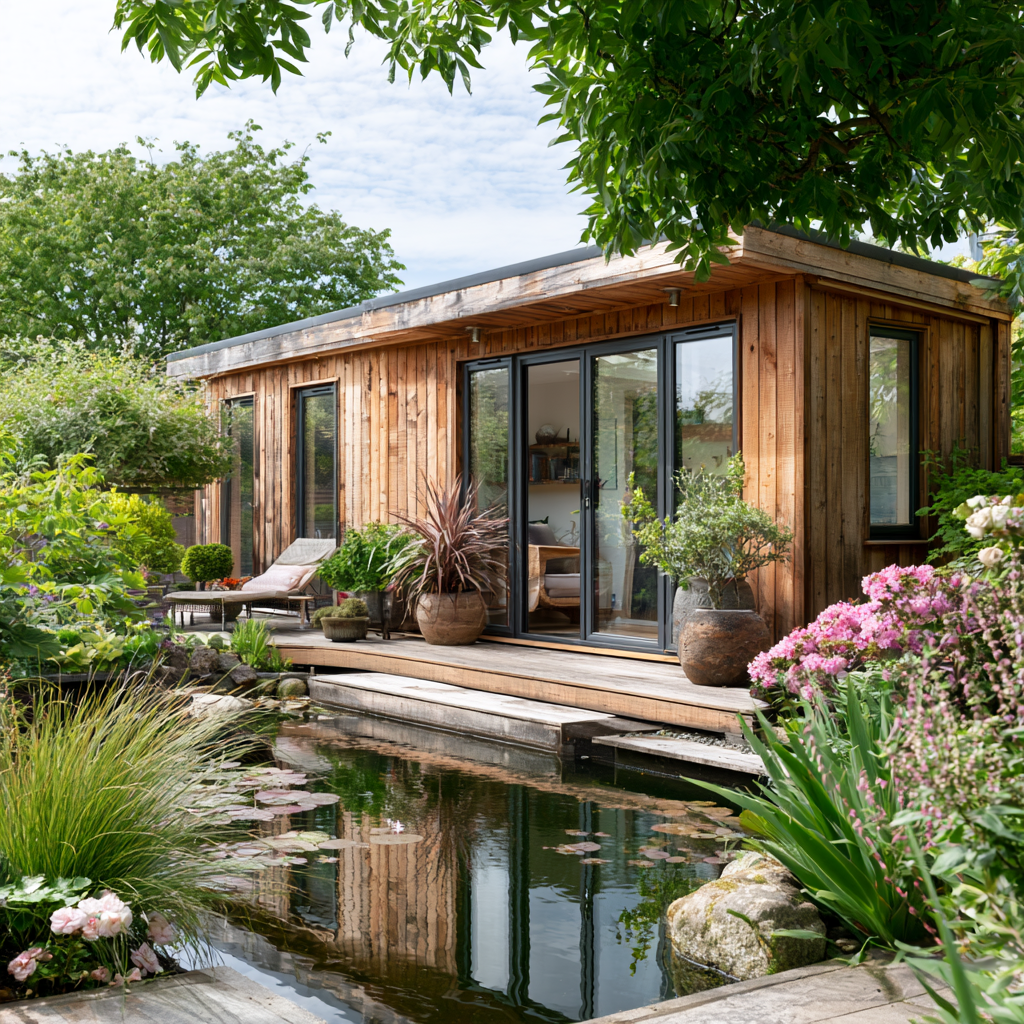
If you are thinking about adding a garden room, upgrading an existing one, or simply giving your outdoor space a more considered finish this year, the material choices you make at the specification stage will determine how your project looks in ten years’ time — not just how it looks on the day it is completed.
The UK garden room market has matured considerably over the past five years. The structures available today are significantly better insulated, better built, and better detailed than those of a decade ago. But the exterior materials used to clad and deck these buildings have not always kept pace. Too many garden rooms — even well-built, well-insulated ones — are still being finished with pressure-treated softwood cladding and decking that will need significant maintenance attention within three to five years.
The good news is that the alternatives are more accessible than ever. Here is what to know before you specify.
Why Timber Species Choice Matters More Than You Think
Not all timber decking performs the same. The species, the modification process, and the profile selection all affect how the material performs in a UK garden environment — and the differences between the best and worst options are not marginal.
Pressure-treated softwood — the standard option supplied by most garden room builders — achieves its durability through chemical impregnation with preservative compounds. It works, but it requires annual or biannual retreatment to maintain that protection as the surface coating degrades. Miss one season and the greening starts. Miss two and the boards begin to show genuine structural fatigue at the fixing points.
Siberian larch is naturally durable without chemical treatment — its density and high resin content give it genuine resistance to biological decay that pressure-treated pine achieves only through chemistry. This means lower maintenance, more consistent appearance over time, and no restrictions on how the timber is disposed of at end of life. For a garden room that is going to be used daily as an office or creative studio, the reduced maintenance commitment is a meaningful quality-of-life benefit.
Siberian larch decking is available in smooth and ribbed profiles to suit different design intentions and practical requirements. The full range of Siberian larch decking UK covers both standard AB grade and premium A grade boards, with options from 28x90mm for narrower deck areas to 28x140mm for wider-board contemporary installations.
What Does a Well-Specified Garden Room Actually Cost?

One of the most consistent frustrations in the garden room market is the gap between initial quoted prices and the final cost of a well-finished project. Base structures are often quoted attractively — and then the upgrades start: better insulation, better windows, better cladding, better decking.
Understanding what those upgrades cost at the outset — and why they represent genuine value rather than upselling — makes the specification conversation much more productive. For cladding, the premium between pressure-treated softwood and a naturally durable timber like Siberian larch or ThermoWood is typically in the range of £15 to £30 per square metre supply cost. On a 30m² garden room with 60m² of total cladded area, that represents a difference of £900 to £1,800 at supply — a fraction of the total project cost, but one that determines the maintenance commitment for the next two decades.
Decking costs follow a similar pattern. Siberian larch decking typically costs £55 to £65 per square metre supplied, compared with £25 to £35 for pressure-treated pine. On a 20m² deck, that is a supply cost difference of £400 to £600 — and an elimination of the annual retreatment cost that pressure-treated decking requires throughout its service life.
For a detailed breakdown of all the costs involved in a garden room project — from structure and glazing through cladding, decking, and landscaping — the garden room cladding cost UK 2026 guide provides current supply prices across all the main cladding species and profiles, with practical guidance on calculating quantities and budgeting for the complete external finish.
The Design Decisions That Make the Biggest Difference

Beyond species and profile, the installation details that most affect the long-term appearance and performance of garden room cladding and decking are often the ones that receive the least attention at the design stage.
For cladding, the specification of a ventilated rainscreen system — with a minimum 25mm drained and ventilated cavity between the boards and the wall structure — is non-negotiable for long-term performance. Without adequate ventilation, even naturally durable timber will show accelerated deterioration at fixing points and board ends where moisture accumulates. The cavity adds a small amount to installation cost but extends the effective service life of any cladding species by decades.
For decking, board orientation and drainage are critical. Boards should run away from the building to shed water, with adequate fall across the deck surface and gaps between boards that allow drainage without accumulating debris. End grain sealing at all cut ends is best practice that adds minimal cost but significantly reduces the moisture uptake that causes end-checking and premature decay at the most vulnerable points of any board.
0
Related
Read the full article here